The Desk-Worker Late Starter
First No-Gi Class, and I Think I'm in Love
Back from the knee layoff at Gracie Barra North Austin. First no-gi class, first arm drag to the back, and the discovery that my fingers finally get a rest.
I’ve been off the mat since I tweaked my knee sparring with a super heavyweight.
That’s becoming a theme. If you’ve read the one about cancelling my membership or the one about the pop in my knee, you know the pattern by now: adult body, contact sport, recurring pauses.
But this post isn’t another layoff post. I came back this week, at Gracie Barra North Austin, and it was the best session I’ve had.
I finally took a no-gi class
First one. Ever.
I’ve been a gi guy by default, not by decision — it’s what the schedule put in front of me. So walking into a no-gi class was less a philosophical choice and more “this is the class that was on.”
Within about ten minutes I understood I’d been missing something.
My fingers got the night off
Here’s the thing nobody told me, and it might be the single most useful sentence in this post for another late starter:
My hands didn’t hurt.
Gi training loads your fingers constantly. You’re hooked into thick fabric, loaded, while someone actively rips it out of your hands, over and over, for an hour. For a guy who types for a living and already has hands with opinions, that’s the part of gi that’s been quietly taxing me the most.
No-gi swapped almost all of that for wrist control, collar ties, underhooks, and just… connecting to a body. The load moved off the small joints and onto the bigger structures. The next morning my hands felt like hands.
I think I’m in love. That’s not a considered position yet, it’s a first impression — but it’s a strong one.
Elbows and forearms, which I’d never used
New tool, first time using it: forearm and elbow pressure on the neck to improve position.
Not as a nasty trick. As a lever. The head goes where you put it, and the body has to follow the head. I’ve read that sentence a hundred times and it meant nothing until I felt somebody’s whole frame reorganize because I moved their chin four inches.
Without a collar to grip, you need something to steer with. Turns out it was attached to my arm the whole time.
The arm drag: a private first, then the replays
Here’s the part I’m most pleased about.
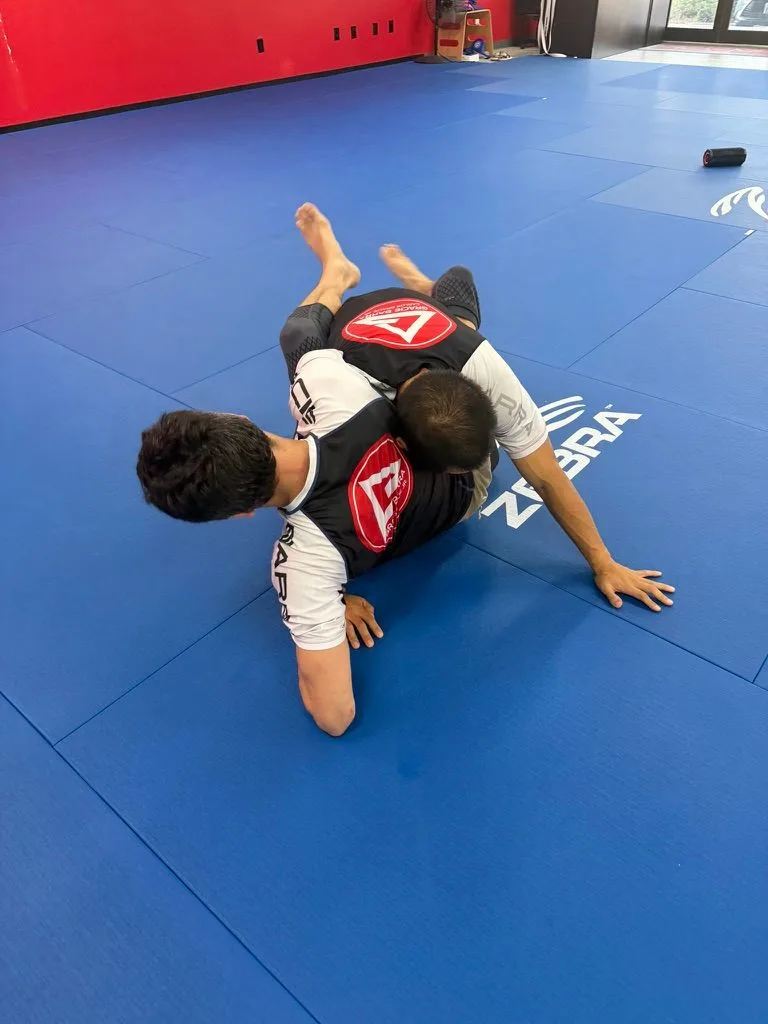
I hit an arm drag to back take, and I initiated a spar with it. First time I’ve ever done it live.
Credit where it belongs: my instructor at Gracie Barra North Austin taught me this in a private lesson. That’s where the actual mechanics came from — the grip, the angle, where my feet needed to be. Not from a screen.
What the film did was make it stick. I’ve spent weeks logging every submission and takedown out of match footage — building a dataset of what fighters actually attempt versus what actually lands — and I’ve now watched Gordon Ryan arm drag more times than I can count. Every rep of that reinforced a thing a coach had already put in my hands.
That’s the honest version of how I learned it, and I think it’s the more useful one: the private gave me the move, the film gave me the pattern recognition to see when it was there.
The data has a lesson in it too, and it’s a humbling one. Across everything we’ve logged, the arm drag converts about a third of the time. In the 2019 ADCC final, Buchecha kills two of Gordon’s arm drags with a simple leg post and goes straight back to work.
So the honest framing of my big moment: I hit a move that fails roughly two times out of three, against a training partner, once. I’m still thrilled.
The bear trap I brought from Bee Cave
The other thing I got to use came from a different room entirely.
I picked this up at Atos Austin over in Bee Cave: one leg entangles theirs like a bear trap, and the other leg pushes their far leg away. They end up doing a bit of the splits, and a person in the splits has nothing left to base with.
I hit it after a scramble following my takedown, and it caught this guy completely off guard. Getting to top position went from a fight to a formality.
That’s the argument for training in more than one room in a sentence. I didn’t learn that at Gracie Barra and I didn’t learn it off a screen — a coach at another gym showed it to me weeks ago, and it sat unused until the exact situation turned up.
One caveat, because it’s a leg entanglement and this site gets read by other beginners: get someone qualified to show you where the pressure goes before you try it on a partner. Knees don’t give much warning.
Cooking them slowly
Getting on top smoothly is where my night peaked, and it’s worth being accurate about what happened next: I lost all of the rounds.
My partner went after my knee several times. Given which knee that is, I gave up position rather than defend it. That’s a trade I’ll make every time — you can win the exchange and lose the next six weeks.
What I was trying to do was cook. Settle weight somewhere uncomfortable, be patient, take the small improvement when it’s offered, start again from slightly better.
What actually happened is I’d get somewhere decent and run out of ideas. I don’t have the next step yet. So my partner would wait me out, sweep me, and submit me. Every single round.
That’s the honest picture — I’ve got the first link of the chain and none of the rest of it.
The chain is the part I’m chasing, and it’s why I keep watching Gordon Ryan film while building this site. His submissions often aren’t the destination. They’re a way to move you somewhere he dominates you even harder — you defend the choke and in defending it you’ve handed him the position he actually wanted.
Doing a bad version of that was a blast anyway. It takes patience, control and balance, and you can feel how much of it is managing your own base while you’re taking away someone else’s.
I won nothing. I also didn’t get hurt, and I learned more in that hour than in any session so far. I’ll take that trade all day.
The mouth guard did its job
I got to spar in the new mouth guards, which — after breaking a tooth — is the difference between rolling relaxed and rolling with a small permanent flinch. Non-event. Which is exactly what you want from safety gear.
I also just talked to the instructor more than I usually do. That sounds small. For someone touring gyms as a stranger it’s actually the whole thing — the sessions that stick are the ones where somebody explains the why and you ask a follow-up instead of nodding.
And the nunchucks
Unrelated to the mat, related to everything else: the nunchuck page is live.
Short version of why. I went looking at what “American made nunchucks” actually means online, and as far as I can tell from my own searching, a lot of it is offshore product bought cheap, re-corded, repriced, and photographed next to a stock woodshop. I couldn’t find someone genuinely turning them here. So we’re making them, out of reclaimed barn wood, and putting the actual lathe on the page instead of a mood photo.
Disclosure, because it matters: the wood comes from Heritage Beam & Board in Elkhorn, Wisconsin, and I’m not a neutral party — I’m their fractional CTO. That relationship is the reason I can get these built out of century-old barn timber at all. It’s also the reason you should know about it before you read me recommending them.
The idea is that the thing funds the road: the drive, the drop-in fees, the privates, the hosting bill for a site that maps gyms nobody’s paying me to review. Give back to the rooms that let me in, promote a client doing genuinely hard salvage work, keep the tour going.
Where that leaves me
Knee held. Hands fine. Learned a lever I didn’t know I had. Hit a move I’d only ever seen on a screen.
And I’m now fairly sure I’m going to be a no-gi guy, which is not what I expected to be writing when I laced up a gi eight months ago.
Back at Gracie Barra North Austin next week. Bringing the mouth guard.
Frequently asked
+Is no-gi easier on your hands and fingers than gi?
In my experience, dramatically. Gi grips put your fingers in a hooked, loaded position for most of a round — you're gripping thick fabric against someone actively trying to rip it out, and the small joints take all of that. No-gi replaces most of those grips with wrist control, collar ties, underhooks and body connection, which load the bigger structures instead. My hands felt normal the next morning for the first time in a while. If your fingers are the thing limiting how often you train, no-gi is worth trying before you conclude the sport doesn't fit you.
+Can you use your elbows and forearms in no-gi BJJ?
Yes, and it's a legitimate part of the game rather than a dirty trick — using forearm and elbow pressure on the jaw, neck and collarbone to move someone's head and open up position. The head goes where you put it and the body follows. The line to respect is that it's for control and position, not for grinding on someone to make them miserable. Ask a coach to show you where the pressure is supposed to land before you start experimenting on training partners.
+How do you do an arm drag to back take?
The short version I was taught: control the wrist, feed the arm across your own centreline so their shoulder turns away from you, and then travel to the space behind that shoulder before they can square back up. The detail I kept getting wrong was treating it as an arm move — the drag is really a way to turn their torso, and the back take is just occupying the space that turning creates. Expect it to fail a lot early. Even elite guys get it stuffed regularly.
+Does training at more than one BJJ gym actually help?
It did for me, concretely. The leg entanglement that won me top position in this class was something a coach at a different gym showed me weeks earlier — I'd never used it, and it sat unused until the exact situation appeared. Different rooms emphasise different things, and the gaps in one place are often the specialty of another. The trade-off is that you progress more slowly in any single curriculum, and some gyms would rather you didn't. Ask before you assume it's fine.
+What does it mean to 'cook' someone in BJJ?
It's positional pressure rather than submission hunting — settling your weight somewhere uncomfortable, staying patient, taking whatever small improvement your partner concedes, and repeating from a slightly better position. The goal is to make holding the current position more expensive than giving ground, so they hand you the next one. It takes real patience, control and balance, and the hard part isn't starting it — it's knowing the next step once they react. Without that chain you just end up somewhere decent with no idea what to do, which is where I currently live.
+Should you defend a submission if it risks re-injuring something?
My personal rule as a late starter is no — I'll concede the position or the tap rather than fight to save it. When a partner went after the knee I've already hurt, I gave up position instead of defending. You can win the exchange and lose six weeks of training, and at this stage the training time is worth far more than the round. Tell your partners about the injury too; most will adjust immediately once they know.
+How long should you wait to train after tweaking your knee in BJJ?
There's no universal number, and I'm a white belt with a blog rather than a clinician. What I go by: I don't come back until the joint carries my bodyweight without complaint through normal daily movement, and then I come back to something lower-intensity than what hurt it. Coming back to a no-gi class rather than straight into hard rounds with the heaviest person in the room was the sensible version of that. Get anything that pops, swells, locks, or won't bear weight looked at properly.